Reading Kanazawa’s teahouse streets: latticework and rooflines in Higashi Chaya and Kazuemachi
A window near the pavement and one above your head can change how the same wooden lattice feels. In Kanazawa’s Higashi Chaya and Kazuemachi districts, try following rooflines and floor heights rather than a list of shops. This is a way to enjoy teahouse architecture from outside.
This is a researched suggestion based on official heritage and transport information, not a reported visit. Historical descriptions and bus fares are checked facts; the order, time allowances and food budget are editorial suggestions.
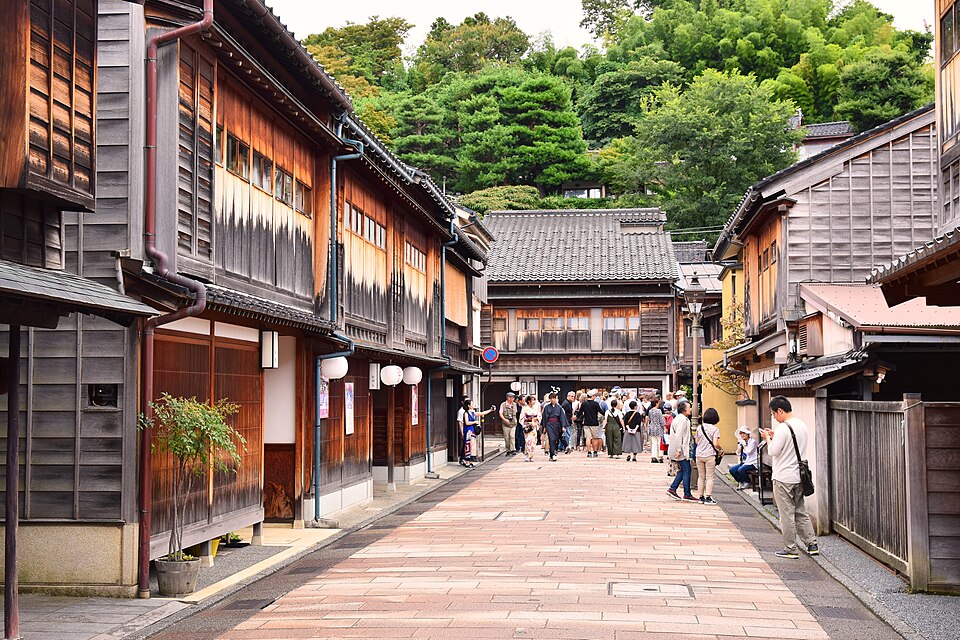
In Higashi Chaya, start by looking up
The Agency for Cultural Affairs describes Higashiyama Higashi as a teahouse quarter laid out on the east bank of the Asano River in 1820. Its account points to projecting ground-floor lattices and tall second floors containing reception rooms.
Compare the lower and upper floors of one building before looking towards its neighbour. You do not need a vocabulary test in architecture. Think about windows and shades at home: how might this facade separate a room from the street? Let that simple question guide where you look.
An exterior cannot tell you the age and interior use of every building. A restaurant, a publicly open historic building and a private home have different entrances and conditions. The name “teahouse district” does not mean every doorway opens into a cafe that anyone can enter.
Across the Asano River, notice the layers of eaves
One option is to return towards Hashiba-cho from Higashi Chaya, cross Asanogawa Ohashi and continue into Kazuemachi. Leave space to look at the streetscape from a little farther away by the river, rather than approaching every facade. Use pavements, crossings and local directions.
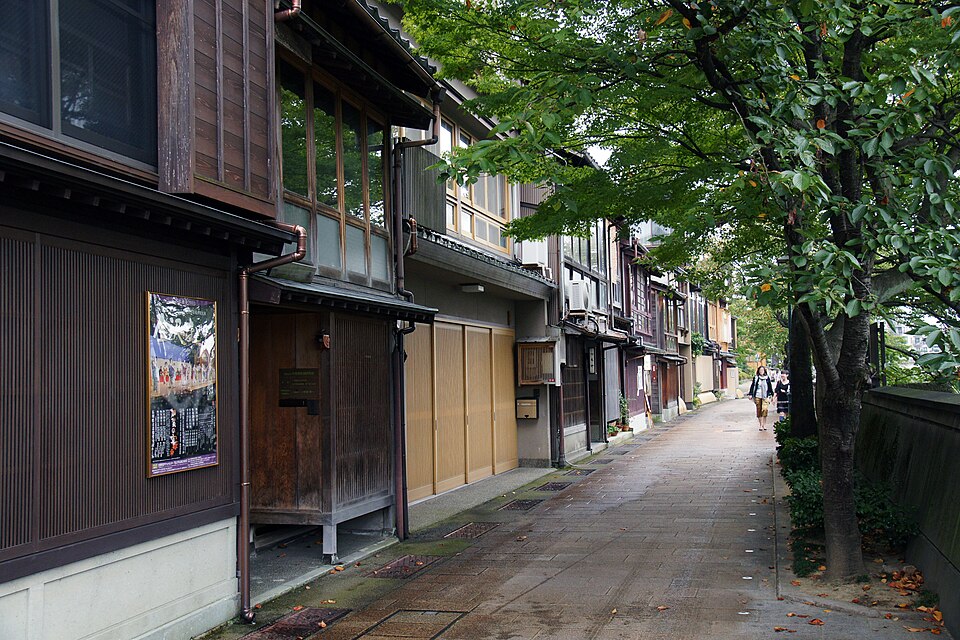
The official Kazuemachi heritage description notes tall two-storey townhouses, many with third floors added in the modern period, as well as eaves and projecting lattices. Recall the upper floors in Higashi Chaya and shift your attention to the number of floors and overlapping rooflines.
There is no need to assign every building in a photograph to one period or peer through windows to inspect the interior. The pleasure here is noticing differences visible from the street. Keep voices down in narrow lanes and move away from entrances, vehicle routes and the path other pedestrians need.
Connect the two districts, with a flexible meal break
The proposed sequence is Hashiba-cho bus stop → Higashi Chaya → back towards Hashiba-cho → Asanogawa Ohashi → Kazuemachi → return towards the station. Allow roughly 75–120 minutes to compare the streets, plus 45–60 minutes for a meal and drink. These are editorial allowances for pauses and queues, not measured walking times or distances.
If a shop you like is busy, look at the buildings first and eat later. Check opening days, ordering conditions, seating and booking requirements with the place you choose. This article does not include a reserved performance, meal or paid building visit, and it does not assume those experiences will be available.
Separate the bus fare from the food budget
Hokuriku Railroad’s timetable revised on 1 April 2026 lists the clockwise Kanazawa Loop Bus from stand 7 at Kanazawa Station’s east exit, at roughly 15-minute intervals. Hashiba-cho for Higashi Chaya and Kazuemachi is about 12 minutes from the station on that timetable. Traffic, queues, diversions and service changes can alter the trip.
The Loop Bus fare per ride is ¥220 for adults, including junior-high-school students and older, and ¥110 for elementary-school children. Two adult rides total ¥440. For the return, check the official map for the station-bound stop and route rather than assuming you can board the opposite direction at the same stop. Other routes can have different fares.
An illustrative adult budget is ¥440 for two Loop Bus rides, ¥1,200–2,000 for lunch and ¥500–900 for a drink, totalling ¥2,140–3,340. Food amounts are estimates, not restaurant quotations. No admission is budgeted for looking at exteriors from public streets. Paid buildings, experiences, shopping, travel to Kanazawa and accommodation are extra.
In rain, shorten the outing rather than chase a photograph
Looking at latticework does not require a long walk in bad weather. In light rain, keep to one district and take a break at a place whose opening you have checked. Eaves are not necessarily public waiting areas: leave entrances clear.
In heavy rain, wind, snow or difficult walking conditions, postponing this outdoor suggestion is reasonable. No indoor replacement is guaranteed. The article also makes no promise of fine weather, open space or a view matching the archive photographs on its planned publication date, 31 October.
Official information and photo sources
Information checked 30 October 2026. Recheck current transport notices and the conditions of any shop or facility you plan to use.
日本語